
General Surgery Instruments
Clear Choice Medical lists new and used general surgery instruments on this page. The listings include surgical forceps and needle holders, along with scissors, clamps and retractors.
1112 products · sorted by price (high to low)


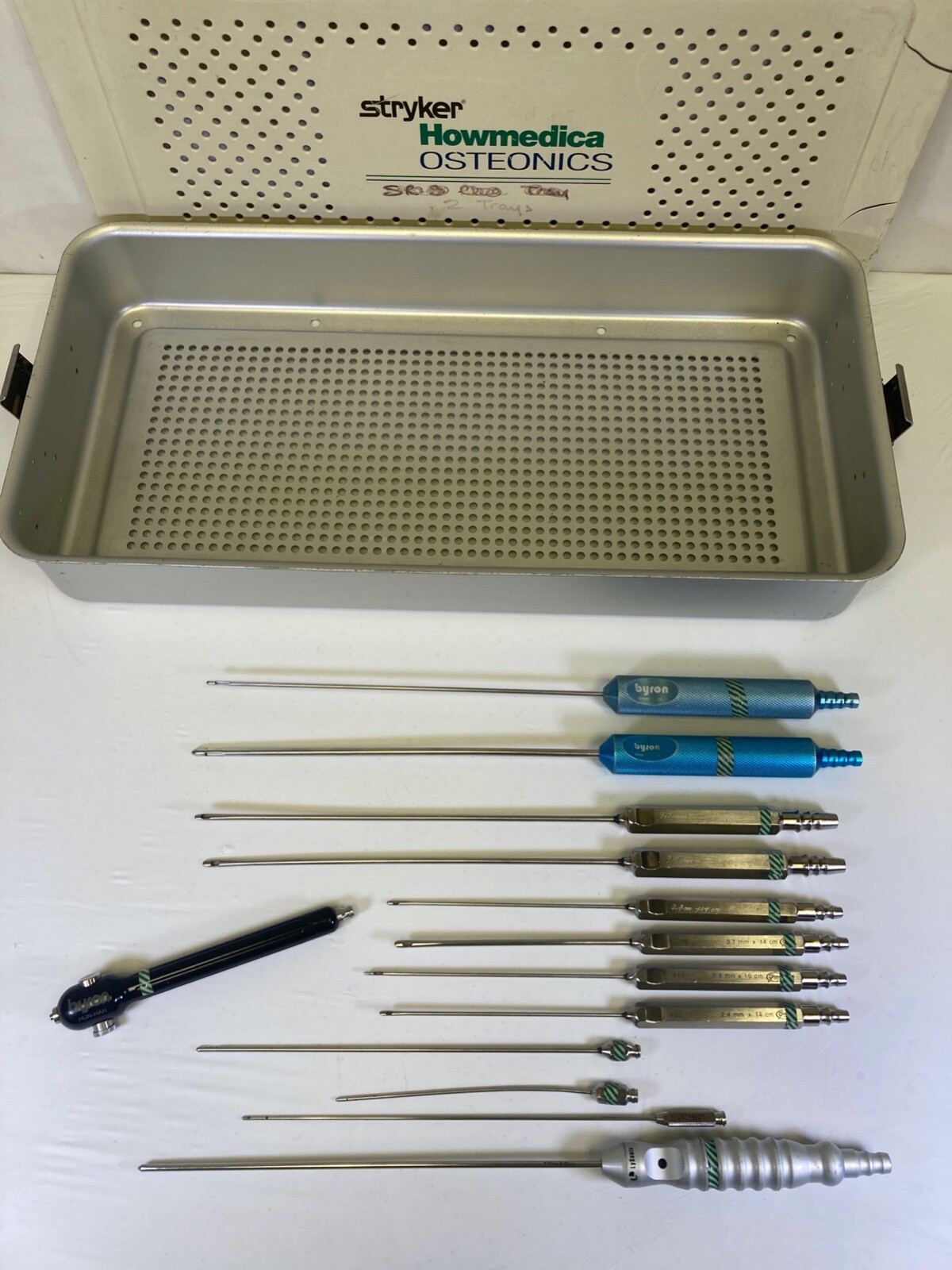


These general surgical instruments fall into a few familiar families. Surgical forceps include Adson, Allis and Babcock patterns next to plain tissue and dressing forceps. Hemostatic forceps come in Crile and mosquito patterns. Metzenbaum scissors and Mayo-Hegar needle holders are also on the page. Surgical retractors run from Weitlaner self-retaining styles to Balfour abdominal frames. Ligating clip appliers, suction tubes and sponge forceps are listed too. Makers on this page include V. Mueller, Codman and Aesculap. Pilling, Miltex and Integra instruments are also listed.
When you compare two similar general surgery tools, start with the overall length and whether the tips are straight or curved. Next, check whether the jaw surface is serrated, smooth or toothed. Tissue forceps titles often state the tooth pattern, such as 1 x 2 teeth. Some needle holders and scissors list tungsten carbide jaws or edges, so check the title for that detail. On clamps and needle holders, note the ratchet and the tip style.
Items come off the page as they sell, so rely on each listing for the model number and exact size. Browse the current general surgery instruments for sale, or contact Clear Choice Medical to match a pattern you already use.
Common questions about General Surgery
What is the difference between Deaver and Richardson retractors?
A Deaver retractor has a thin, flat blade shaped like a question mark, while a Richardson has a right-angled blade with a lipped tip. Sklar describes both as hand-held retractors. Sklar lists Deaver retractors in several lengths and blade widths. One Sklar Deaver has a 1 inch wide blade and a 12 inch overall length. Sklar offers Deaver handles in grip and flat styles. Sklar lists its small Richardson with a 3/4 x 1 inch blade and a 9-1/2 inch overall length. The Richardson-Eastman pattern is double-ended, with a different blade size at each end. The Aesculap catalog lists one Deaver as Fig 00, with a 59 mm jaw depth and a 22 mm jaw width. When you compare two listings, check the blade dimensions, the overall length and the handle style.
What is the difference between Frazier, Poole and Yankauer suction tubes?
A Frazier is a thin tube with a thumb hole, a Poole has a perforated outer sheath and a Yankauer has a bulb tip. Sklar says the handle hole controls suction and a thin wire clears tissue trapped in the tube. Sklar also says the French gauge measures outside diameter, with 3 French equal to 1 mm. Sklar's 6 French Frazier has a 2 mm tip. On some Poole tubes, the perforated outer sheath comes off to leave a smaller inner tip. JEDMED lists its Yankauer with a removable 9 mm bulbous tip. When you compare listings, check the French size, the overall length and the working length. Also note whether the title says straight, angled or curved.
What do small, medium and large mean on a ligating clip applier?
The size on a ligating clip applier names the clip it is made to close, not the size of the instrument. Teleflex says each Weck applier is designed for one specific clip line, such as Horizon, Hemoclip or Hem-o-lok. Horizon clips run from MicroClip and small through medium and medium-large to large. Horizon applier color coding matches the color of the clip cartridge it is meant to use. In the Horizon open applier catalog, the first digit of the product number changes with the clip size. For example, 137081 is a small 8 inch curved applier and 437081 is a large one. Teleflex gives Horizon open applier jaw angles as 20 degrees curved, 55 degrees angled and 70 degrees right-angled. Catalogs and titles may shorten medium-large to ML or M/L. When you compare listings, check the clip line and clip size before the length and jaw angle.